For many health supplement brands, Halal is no longer a "nice to have". Importers in the Gulf, Malaysia, Indonesia, Nigeria and the Muslim communities of the UK and Europe often ask for a Halal certificate before they ask for a price. If you are looking for a Halal supplement manufacturer in India, this guide explains what to check before you place an order.
It is written for brand owners, importers, distributors and private label sellers who buy manufacturing, not for shoppers. It covers which dosage forms suit Halal markets, the gelatin and shell choices that matter most, how to read a Halal certificate, the rules in key export markets, the documents an importer needs, and a short brief you can send to a Halal softgel and health supplement manufacturer for a quotation.
Why Halal Matters for Supplement Brands
Halal is about what goes into the product and how it is made. For a health supplement, the questions usually come down to three things: animal-derived ingredients (most often gelatin), alcohol-based ingredients such as some flavours and extracts, and the way the factory keeps Halal and non-Halal materials apart.
The demand is real and it is not only in Muslim-majority countries. Google Ads data shows these average monthly searches (October 2025 to September 2026):
| Search term | United Kingdom | Malaysia | India |
|---|---|---|---|
| halal omega 3 | about 480 | about 10 | about 140 |
| halal gummies | about 320 | about 170 | about 90 |
| halal supplements | about 260 | about 70 | about 20 |
| halal fish oil | about 110 | about 30 | about 110 |
These are shopper searches, but they tell a brand owner where Halal products sell. Omega-3 and gummies lead, which is why softgel shells and gummy bases are the first things a Halal buyer asks about.
Choosing a Halal Supplement Manufacturer in India: Four Business Models
| Model | How it works | Best for |
|---|---|---|
| Third party manufacturing | The manufacturer makes and packs the product in its own Halal-certified facility; you sell it under your brand. | Brands that do not want to run a factory |
| Private label / white label | You pick a ready product from the manufacturer's range and add your label. | New brands and fast launches |
| Contract manufacturing | You send your formula; the manufacturer checks every ingredient for Halal status and makes it to your specification. | Brands with an existing product |
| OEM / ODM | The manufacturer develops the formula from your brief, choosing Halal-suitable ingredients from the start. | Brands that want their own, different product |
In every model, agree in writing who owns the formula. At Infy Life Science, a formula you give us stays yours.
Dosage Forms for Halal Markets
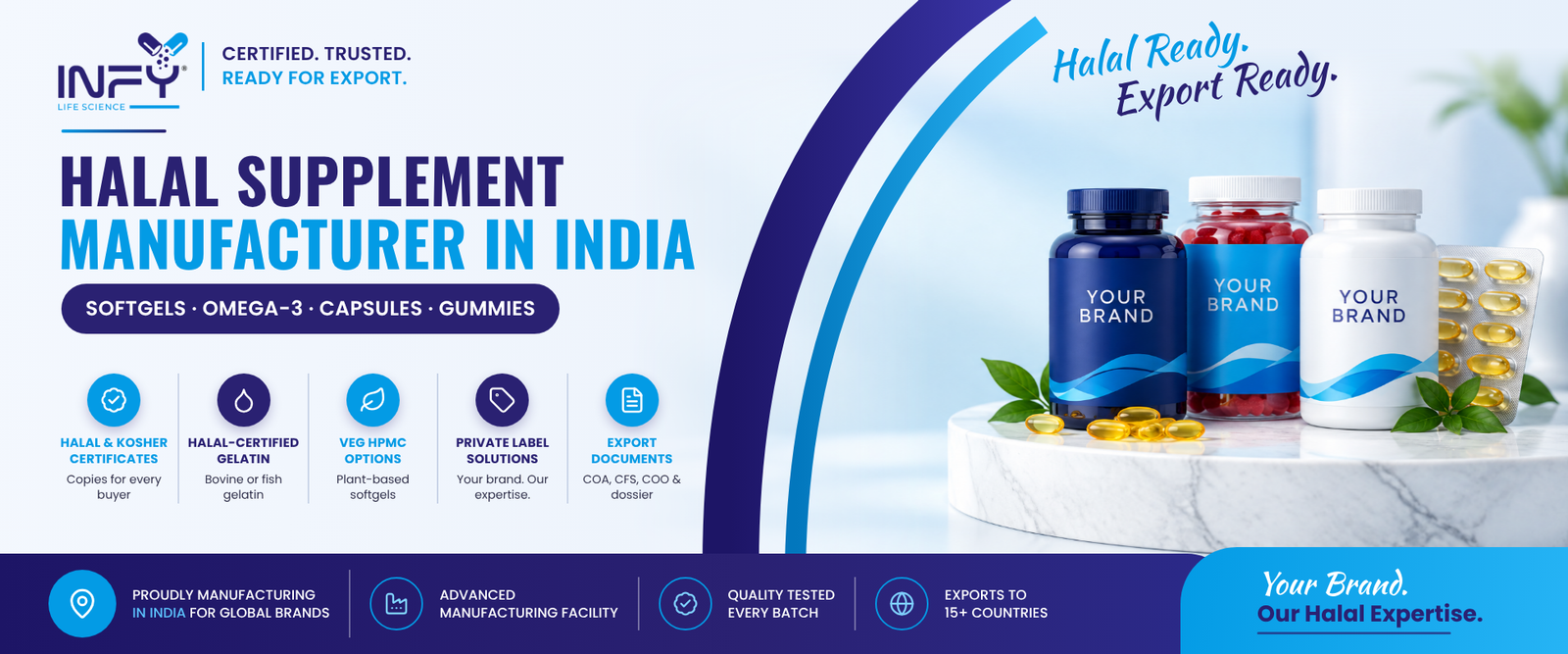
- Gelatin softgels: the gelatin is the key point. Our gelatin softgels use Halal-certified bovine or fish gelatin, chosen to suit your order. Fish oil, omega-3, vitamin D3, vitamin E and other oil-based fills are made this way. See our softgel range.
- Vegetarian softgels: an HPMC (plant cellulose) shell with no animal gelatin at all. When every ingredient is plant-based, the product can also be labelled vegan. See vegetarian softgel capsules.
- Gummies: our gummies are made with pectin, a plant-based gelling agent, not gelatin. See the gummy range.
- Capsules: vegetarian HPMC capsules avoid the gelatin question. If you prefer hard gelatin capsules, ask for the shell supplier's Halal certificate before you approve the sample.
- Tablets, effervescent tablets, powders and sachets: no shell, so the checks move to the actives, the excipients, the flavours and any colours.
Halal Omega-3 Softgels: What to Specify
Omega-3 is the most searched Halal supplement in our data, so it deserves its own checklist:
- Shell: Halal-certified bovine gelatin, Halal-certified fish gelatin (some buyers prefer an all-fish product), or a plant-based HPMC shell.
- Fish oil grade: 18/12 (standard), 30/20, triple strength 45/32 and higher, or 4x up to 8x strength. Any grade on request.
- Cod liver oil: 300 mg, 500 mg or 1,000 mg softgels, or any strength on request, with vitamin A and D levels set to your specification.
- Shape, size and colour: oval, oblong or round, any fill size and any shell colour on request.
- Flavour and other additives: ask for the Halal status of each one. Some flavours are carried in alcohol.
- Pack: HDPE or PET bottles, blister packs, alu-alu packs or bulk packing.
Minimum order quantity for softgels at Infy Life Science is 30,000 softgels for gelatin softgels and 1,00,000 softgels for vegetarian softgels. More detail is in our softgel manufacturer buyer's guide and on our omega-3 fish oil page.
How to Check a Halal Certificate
A Halal logo on a website is not enough. Before you approve a supplier, check:
- The certification body: is it recognised by the authority in your market (for example JAKIM in Malaysia or BPJPH in Indonesia, or the relevant body in the UAE and Saudi Arabia)?
- The address: does it match the factory that will make your product?
- The scope: does it cover your dosage form and your product, or only some lines?
- The expiry date: certificates must be renewed. Ask for the current copy, not an old one.
- The raw materials: ask for the Halal certificate of the gelatin and of any other animal-derived or alcohol-based ingredient.
Infy Life Science makes health supplements in its own facility near Ahmedabad, Gujarat, which holds Halal, Kosher, WHO-GMP, ISO 22000:2018 and HACCP certificates and an FSSAI licence. We share copies with buyers, and our softgel gelatin is Halal certified.
Market Rules: Gulf, Southeast Asia, Africa and the UK
- Indonesia: from 18 October 2026, health supplements sold in Indonesia must be Halal certified or labelled as non-Halal. The rule covers imports, and a foreign Halal certificate must come from a body Indonesia recognises and be registered in its SIHALAL system, as Halal Times reports. Check your manufacturer's certifier before you plan a shipment.
- Malaysia: buyers usually ask whether the certifier is recognised by JAKIM, and want the gelatin source documents.
- Gulf (UAE, Saudi Arabia, Oman, Kuwait, Qatar): importers ask for the Halal certificate, English and Arabic labels, and product registration, which is usually done by the local importer with the manufacturer's dossier.
- Africa: Nigeria (NAFDAC) and Kenya (PPB) need product registration before sale. Halal is often asked for in northern Nigeria, East Africa and Egypt.
- UK and Europe: Halal is a voluntary claim, but retailers and community distributors often ask for the certificate. The product must still meet the local food supplement rules, which the brand owner usually checks with a local adviser.
- India: health supplements fall under the FSSAI Health Supplements and Nutraceuticals Regulations, 2016. Medicinal or disease claims are not allowed on the label in any market.
Documents an Importer Should Ask For
- Halal certificate of the facility, and Halal certificates of the gelatin and other key raw materials
- Batch Certificate of Analysis (COA) and the product specification
- Stability data
- Certificate of Free Sale (CFS) and Certificate of Origin (COO)
- Copies of WHO-GMP, ISO 22000, HACCP and Kosher certificates
- The product registration dossier for your country, for example for NAFDAC in Nigeria, PPB in Kenya or the Gulf authorities
Infy Life Science provides all of these for export orders. We give free samples before an order, and a first order is usually ready 3 to 4 weeks after artwork approval.
Ten Questions to Ask a Halal Supplement Manufacturer
- Which body issued your Halal certificate, and is it recognised in my country?
- Does the certificate cover my dosage form, and is it current?
- Is the gelatin bovine, fish or plant-based, and can I see its Halal certificate?
- Are the flavours, colours and extracts free of alcohol and animal sources?
- How do you keep Halal and non-Halal materials apart in the factory?
- Do you make the product in your own facility, or do you outsource?
- Who owns the formula, and will you put that in writing?
- Can I get free samples, and what is the lead time for the first order?
- Which export documents and registration dossier can you give for my country?
- Can you prepare English and Arabic label text for my market?
A Brief to Send for a Quotation
Copy this list into your email. The more you fill in, the faster and more accurate the quotation will be:
- Product and dosage form (softgel, vegetarian softgel, gummy, capsule, tablet, powder or sachet)
- Your formula with the amount of each active per serving (or "please suggest a formula")
- For softgels: shell (bovine gelatin, fish gelatin or HPMC), fish oil grade, shape and colour
- Business model: third party, private label, contract or OEM / ODM
- Pack: bottle, blister, alu-alu or bulk, and count per pack
- Quantity for the first order and expected yearly volume
- Country of sale and the Halal body your importer accepts
- Your target launch date
Frequently Asked Questions
Is Infy Life Science Halal certified?
Yes. Our facility holds a Halal certificate, as well as Kosher, WHO-GMP, ISO 22000:2018 and HACCP certificates and an FSSAI licence. We share copies with buyers on request.
Is the gelatin in your softgels Halal?
Yes. Our gelatin softgels use Halal-certified bovine or fish gelatin. For a product with no animal gelatin, choose our HPMC vegetarian softgels.
Do your gummies contain gelatin?
No. Our gummies are made with pectin, a plant-based gelling agent.
Do you export Halal softgels?
Yes. We have exported softgels to the Gulf, Africa, Asia, Europe, North America, Australia and Canada, and we provide the COA, specification, stability data, Certificate of Free Sale, Certificate of Origin and registration dossier.
What is the minimum order for Halal softgels?
30,000 softgels for gelatin softgels and 1,00,000 softgels for vegetarian softgels. For other dosage forms, tell us your product and quantity and we will confirm it in the quotation.
Request a Quotation
Send your brief and we will reply with options, samples and a quotation, or send an enquiry.
- Email ID: info@infylifescience.com
- Call & WhatsApp: (+91) 9023933030
Filed under
Infy Life Science Team
Sharing perspectives on Omega-3, nutraceutical manufacturing and product science.