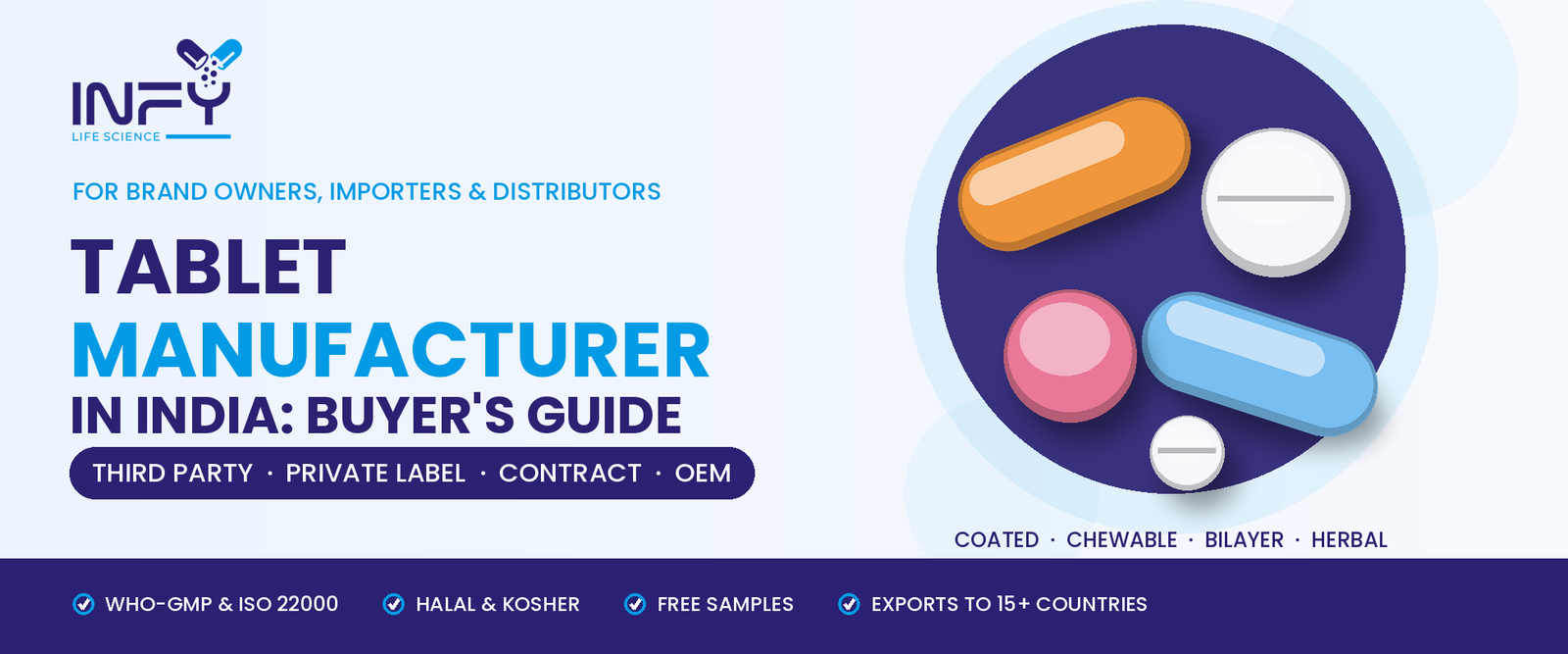
Tablets are still the most common format for health supplements. Multivitamins, minerals, vitamin C, B-complex, biotin and herbal extracts are all sold as tablets in India, the Gulf, Africa, Asia, Europe and North America. They are compact, stable, easy to pack and cost less per dose than most other formats.
That is why more brands are now looking for a tablet manufacturer in India. But tablet makers differ a lot in the tablet types they can make, the quality checks they run, the label support they give and the documents they can hand an importer. This guide is written for brand owners, importers, distributors and private label sellers. It explains what to compare and ends with a short brief you can send for a quotation.
Four Ways to Work With a Tablet Manufacturer
First decide how much of the product you want to own. There are four common models:
| Model | How it works | Best for |
|---|---|---|
| Third party manufacturing | The manufacturer makes the tablets in its own facility; you market them under your brand. | Brands that do not want to build or run a plant |
| Private label | You pick a ready formula from the manufacturer's range and launch it under your own label and pack design. | New brands and fast launches |
| Contract manufacturing | You give your own formula and specification; the manufacturer produces to it. | Brands with an existing product or formula |
| OEM / ODM | The tablet is made to your requirements, or the formula is developed for you from a brief. | Brands that want a product competitors cannot copy |
In every model, agree in writing who owns the formula. At Infy Life Science, a formula you give us stays yours, and for a unique formula we sign an agreement not to make the same composition for another brand.
Which Tablet Type Fits Your Product?
"Tablet" covers several different products. The type you choose changes the machine time, the coating, the pack and the price. A good manufacturer will help you choose, but it helps to know the options:
| Tablet type | What it is | Why brands choose it |
|---|---|---|
| Film coated | A thin coating over the compressed tablet | Masks taste and smell, adds colour, easier to swallow, protects from moisture |
| Non-coated | A plain compressed tablet | Simple and economical for neutral-tasting formulas |
| Chewable | A flavoured tablet meant to be chewed | For buyers who dislike swallowing tablets; vitamin C is a common example |
| Bilayer | Two layers pressed into one tablet | Keeps two ingredient blends apart in one product; strong shelf appeal |
| Sustained release | Built to release the ingredients slowly | Premium positioning for some vitamin formulas |
| Sublingual | A small tablet that dissolves under the tongue | Small dose formats such as some B-vitamins |
| Effervescent | Dissolves in water to make a drink | High-dose vitamins and electrolytes; sold in tubes |
At Infy Life Science we make coated, non-coated, chewable, bilayer, sustained-release and sublingual tablets, plus multivitamin, mineral and herbal tablets. Effervescent tablets have their own guide: see our effervescent tablet manufacturing page.
What Brands Put in Tablets
The tablet is a good format for dry ingredients that are stable when pressed. The categories we are asked for most are:
- Multivitamins and multiminerals, such as our multivitamin and multimineral tablets.
- Single vitamins such as vitamin C, B-complex and biotin.
- Minerals such as calcium with zinc and vitamin D3, and magnesium bisglycinate.
- Herbal and botanical extracts such as ashwagandha and spirulina.
- Speciality ingredients such as myo-inositol.
Oils and oil-soluble actives such as omega-3 are better in softgels. Very high doses (several grams) may need a powder, sachet or effervescent format instead of a tablet that is too big to swallow. Ask the manufacturer to tell you early if your formula will not fit a tablet of a practical size.
How to Judge Tablet Quality Before You Order
A tablet can look fine on day one and fail on the shelf. Ask for these checks on the sample and on every batch:
- Assay of actives: does each tablet carry the amount on the label?
- Weight variation: are the tablets in a batch the same weight?
- Hardness and friability: will the tablets survive shipping without breaking or turning to dust?
- Disintegration: does the tablet break down in the time the specification allows?
- Moisture: important for humid markets such as West Africa and South Asia.
- Stability data: proof that the tablet keeps its quality to the end of its shelf life.
Also check the factory itself. Infy Life Science makes tablets in its own facility near Ahmedabad, Gujarat, which holds WHO-GMP, ISO 22000:2018, HACCP, Halal and Kosher certificates and an FSSAI licence. Ask any supplier for copies of their certificates and check that the address on them matches the factory that will make your product.
Label Rules: India and Export Markets
The label is where many new brands run into trouble, so plan it with your manufacturer from the start.
- India: health supplement tablets fall under the FSSAI Health Supplements and Nutraceuticals Regulations, 2016. On 20 October 2026, FSSAI warned supplement makers about labelling lapses, especially the mandatory warning statements for plant and botanical ingredients and their extracts. If you sell herbal tablets in India, check these warnings on your artwork before printing. Medicinal or disease claims are not allowed.
- Gulf (UAE, Saudi Arabia, Oman, Kuwait, Qatar): buyers often ask for Halal certification and bilingual (English and Arabic) labels. Product registration is usually done by the local importer.
- Africa: markets such as Nigeria (NAFDAC) and Kenya (PPB) need product registration before sale, which needs a dossier from the manufacturer.
- UK, Europe, USA and Australia: tablets are sold as food supplements or dietary supplements, each with its own label and ingredient rules. The brand owner usually confirms the final label with a local regulatory adviser.
Documents an Importer Should Ask For
If you import tablets from India, your customs agent and your regulator will ask for paperwork. For every export order, Infy Life Science provides:
- Batch Certificate of Analysis (COA) and the product specification
- Stability data
- Certificate of Free Sale (CFS)
- Certificate of Origin (COO)
- Copies of our WHO-GMP, ISO 22000, HACCP, Halal and Kosher certificates
- The product registration dossier for your country, for example for NAFDAC in Nigeria, PPB in Kenya or the Gulf authorities
Lead Time, Samples and Capacity
Ask every supplier the same three questions and compare the answers:
- Samples: we give free samples before an order, so you can check taste, size and finish.
- Lead time: a first order is usually ready 3 to 4 weeks after artwork approval.
- Capacity: our facility makes up to 1 lakh (100,000) tablets per batch, so repeat orders do not wait in a long queue.
Minimum order quantity depends on the tablet type, the formula and the pack. Tell us your product and target quantity and we will confirm it in the quotation.
Ten Questions to Ask a Tablet Manufacturer
- Do you make the tablets in your own facility, or do you outsource?
- Which certificates do you hold, and does the address match the factory?
- Which tablet types can you make: coated, chewable, bilayer, sustained release?
- Who owns the formula, and will you sign an agreement on it?
- What tests are on the batch COA?
- Do you have stability data for this formula or a similar one?
- Can I get free samples before I order?
- What is the lead time from artwork approval to dispatch?
- Which export documents and registration dossier can you give for my country?
- Will you check my label against the rules of my market before printing?
A Brief to Send for a Quotation
Copy this list into your email. The more you fill in, the faster and more accurate the quotation will be:
- Product name and your formula (or "please suggest a formula")
- Tablet type (coated, chewable, bilayer and so on) and any colour or shape you want
- Business model: third party, private label, contract or OEM / ODM
- Pack: tablets per pack and the pack type you have in mind
- Quantity for the first order and expected yearly volume
- Country of sale, and whether you need Halal, Kosher or a registration dossier
- Your target launch date
If you are planning a daily multivitamin, our guide to choosing a multivitamin and multimineral supplement manufacturer covers that product in more detail.
Frequently Asked Questions
Do you offer third party and private label tablet manufacturing?
Yes. We make health supplement tablets on a third party, private label, contract and OEM / ODM basis for brands in India and abroad.
Can you make tablets to my own formula?
Yes. Send your formula and specification. The formula stays yours, and for a unique formula we sign an agreement not to make it for another brand.
Do you export tablets?
Yes. Infy Life Science exports health supplements to 15+ countries and provides the COA, specification, stability data, Certificate of Free Sale, Certificate of Origin and registration dossier.
Are your tablets Halal?
Our facility holds Halal and Kosher certificates. Tell us if your market needs Halal so we can plan the ingredients and documents for it.
How long does a first tablet order take?
Usually 3 to 4 weeks from artwork approval to dispatch, after you have approved the samples.
Request a Quotation
Send your brief and we will reply with options, samples and a quotation. See our tablets range or send an enquiry.
- Email ID: info@infylifescience.com
- Call & WhatsApp: (+91) 9023933030
Filed under
Infy Life Science Team
Sharing perspectives on Omega-3, nutraceutical manufacturing and product science.