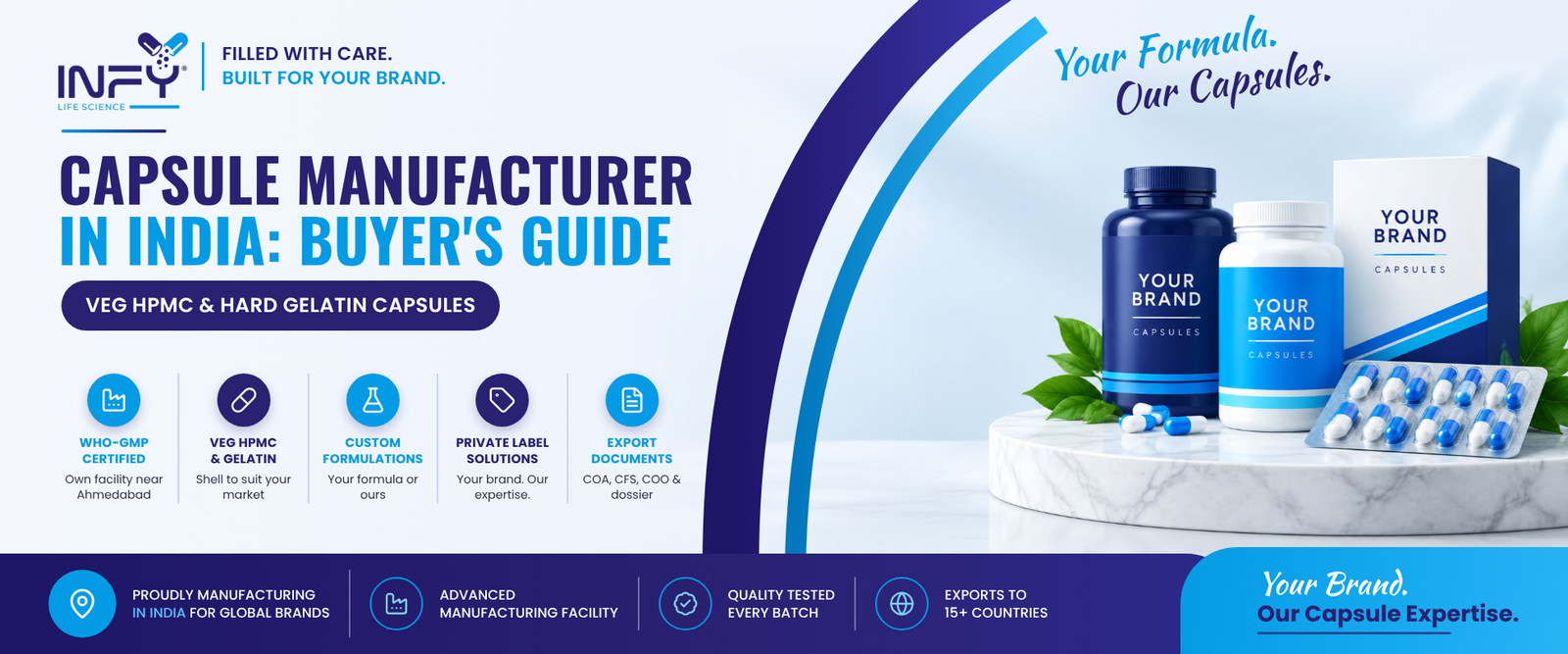
Capsules are one of the easiest ways to launch a health supplement brand. Probiotics, herbal extracts, CoQ10, curcumin and joint formulas are all sold as capsules in India, the Gulf, Africa, Asia, Europe and North America. If you are looking for a capsule manufacturer in India, this guide explains what to compare before you place an order.
It is written for brand owners, importers, distributors and private label sellers who buy manufacturing, not for shoppers. It covers the two shell types (vegetarian HPMC and hard gelatin), the four business models, the quality checks, the label rules in India and export markets, the documents an importer needs, and a short brief you can send to a capsule manufacturer for a quotation.
Choosing a Capsule Manufacturer in India: Four Business Models
Start by deciding how much of the product you want to own. Most capsule suppliers in India work in one or more of these four ways:
| Model | How it works | Best for |
|---|---|---|
| Third party manufacturing | The manufacturer fills and packs the capsules in its own facility; you sell them under your brand. | Brands that do not want to run a factory |
| Private label | You pick a ready product from the manufacturer's range, choose the shell and pack, and add your label. | New brands and fast launches |
| Contract manufacturing | You send your formula and specification (actives per capsule, capsule size, shell); the manufacturer fills to it. | Brands with an existing product |
| OEM / ODM | The manufacturer develops the formula from your brief and checks it fits the capsule size you want. | Brands that want their own, different product |
In every model, agree in writing who owns the formula. At Infy Life Science, a formula you give us stays yours, and for a unique formula we sign an agreement not to make the same composition for another brand.
Veg HPMC or Hard Gelatin: Which Shell Should You Choose?
The shell is the first decision that affects your label, your market and your buyers. Here is a simple comparison:
| Point to compare | Vegetarian HPMC capsules | Hard gelatin capsules |
|---|---|---|
| Shell made from | Plant cellulose (hydroxypropyl methylcellulose) | Gelatin, an animal-derived protein |
| Vegetarian / vegan label | Yes, if all the fill ingredients are plant-based too | No |
| Halal and religious markets | Avoids the animal-source question, so it is often asked for by Gulf and Halal-focused buyers | Buyers will ask for the gelatin source and its certificate |
| Common uses | Vegetarian and vegan brands, herbal capsules, probiotics, export ranges | Products where the shell type does not matter to your buyers |
| Indian market note | A vegetarian product can carry the green dot on its Indian pack | Needs the non-vegetarian (brown) mark on Indian packs |
Infy Life Science fills both vegetarian HPMC capsules and hard gelatin capsules. If you are not sure, tell us your market and your buyers and we will suggest the shell. For oils such as omega-3, a capsule is the wrong format: see our vegetarian softgel capsules instead.
What Brands Put in Capsules
Capsules suit dry powders and extracts, especially ingredients with a strong taste or smell that would need coating in a tablet. Our capsule range has more than 40 products. The groups we are asked for most are:
- Probiotics, such as our pre and probiotic capsules.
- Speciality actives such as CoQ10, NAC, NMN, berberine with milk thistle, and curcumin with bioperine.
- Joint formulas such as glucosamine with chondroitin and MSM.
- Herbal and Ayurvedic extracts such as ashwagandha, moringa, shilajit, safed musli and fenugreek.
- Multivitamin blends, including multivitamins with pre and probiotics.
One practical limit: a capsule holds a fixed volume of powder. If your daily amount is large, the label may need two or more capsules per serving, or a powder or sachet format may suit better. Ask the manufacturer to check the fill before you print any artwork.
How to Judge Capsule Quality Before You Order
Ask for these checks on the sample and on every batch Certificate of Analysis (COA):
- Assay of actives: does each capsule carry the amount on the label?
- Fill weight variation: are the capsules in a batch filled evenly?
- Disintegration: does the shell open in the time the specification allows?
- Moisture: too much moisture softens or cracks shells and harms some ingredients. This matters most for humid markets such as West Africa and South Asia.
- Microbiology: ask how and where microbial tests are done, especially for herbal powders.
- Stability data: proof that the capsule keeps its quality to the end of its shelf life in the pack you choose.
Check the factory as well as the product. Infy Life Science fills capsules in its own facility near Ahmedabad, Gujarat, which holds WHO-GMP, ISO 22000:2018, HACCP, Halal and Kosher certificates and an FSSAI licence. Ask any supplier for copies of their certificates and check that the address matches the factory that will make your product.
Packs for Capsules
The pack protects the capsule from moisture and decides how it looks on the shelf. Common options are:
- HDPE or PET bottles and jars: the usual choice for retail and online sale.
- Blister packs: popular with pharmacies and for strip-wise sale.
- Alu-alu packs: the strongest moisture barrier, often chosen for probiotics and hot, humid markets.
Label Rules: India and Export Markets
- India: health supplement capsules fall under the FSSAI Health Supplements and Nutraceuticals Regulations, 2016. In an advisory dated 15 October 2026, FSSAI said it is enforcing the mandatory label warnings for plant ingredients listed in Schedule IV, such as neem, coffee seed and Coleus forskohlii, with permitted usage ranges. Non-compliance can lead to licence suspension. Herbal capsule brands should check every warning on the artwork before printing. Medicinal or disease claims are not allowed.
- Gulf (UAE, Saudi Arabia, Oman, Kuwait, Qatar): buyers often ask for Halal certification and English and Arabic labels. Registration is usually done by the local importer.
- Africa: markets such as Nigeria (NAFDAC) and Kenya (PPB) need product registration before sale, which needs a dossier from the manufacturer.
- UK, Europe, USA and Australia: capsules are sold as food supplements or dietary supplements, each with its own label and ingredient rules. The brand owner usually confirms the final label with a local regulatory adviser.
Documents an Importer Should Ask For
For export orders, Infy Life Science provides:
- Batch Certificate of Analysis (COA) and the product specification
- Stability data
- Certificate of Free Sale (CFS)
- Certificate of Origin (COO)
- Copies of our WHO-GMP, ISO 22000, HACCP, Halal and Kosher certificates
- The product registration dossier for your country, for example for NAFDAC in Nigeria, PPB in Kenya or the Gulf authorities
Lead Time, Samples and Capacity
- Samples: we give free samples before an order, so you can check the shell, colour and fill.
- Lead time: a first order is usually ready 3 to 4 weeks after artwork approval.
- Capacity: our facility makes up to 1 lakh (100,000) capsules per batch.
Minimum order quantity depends on the product, the shell and the pack. Tell us your product and target quantity and we will confirm it in the quotation.
Ten Questions to Ask a Capsule Manufacturer
- Do you fill the capsules in your own facility, or do you outsource?
- Which certificates do you hold, and does the address match the factory?
- Can you fill both vegetarian HPMC and hard gelatin capsules?
- Will my daily amount fit in one capsule, and which capsule size do you suggest?
- Who owns the formula, and will you sign an agreement on it?
- Which tests are on the batch COA, and where is microbiology tested?
- Do you have stability data for this formula and pack?
- Can I get free samples before I order, and what is the lead time?
- Which export documents and registration dossier can you give for my country?
- Will you check my label against the rules of my market, including FSSAI plant warnings, before printing?
A Brief to Send for a Quotation
Copy this list into your email. The more you fill in, the faster and more accurate the quotation will be:
- Product name and your formula with the amount of each active per capsule (or "please suggest a formula")
- Shell: vegetarian HPMC or hard gelatin, and any shell colour you want
- Business model: third party, private label, contract or OEM / ODM
- Pack: capsules per pack and bottle, jar, blister or alu-alu
- Quantity for the first order and expected yearly volume
- Country of sale, and whether you need Halal, Kosher, vegan wording or a registration dossier
- Your target launch date
Planning a probiotic range? Our guide to choosing a probiotic supplement manufacturer in India covers that product in more detail. If you are comparing formats, see also our tablet manufacturer buyer's guide.
Frequently Asked Questions
Do you offer third party and private label capsule manufacturing?
Yes. We fill and pack health supplement capsules on a third party, private label, contract and OEM / ODM basis for brands in India and abroad.
Do you make vegetarian (HPMC) capsules?
Yes. We fill both vegetarian HPMC capsules and hard gelatin capsules. HPMC capsules suit vegetarian, vegan and many export brands.
Can you fill capsules to my own formula?
Yes. Send your formula, the actives per capsule and the shell you want. The formula stays yours, and for a unique formula we sign an agreement not to make it for another brand.
Do you export capsules?
Yes. Infy Life Science exports health supplements to 15+ countries and provides the COA, specification, stability data, Certificate of Free Sale, Certificate of Origin and registration dossier.
How long does a first capsule order take?
Usually 3 to 4 weeks from artwork approval to dispatch, after you have approved the samples.
Request a Quotation
Send your brief and we will reply with options, samples and a quotation. See our capsules range or send an enquiry.
- Email ID: info@infylifescience.com
- Call & WhatsApp: (+91) 9023933030
Filed under
Infy Life Science Team
Sharing perspectives on Omega-3, nutraceutical manufacturing and product science.